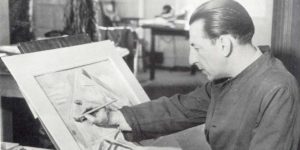
 He was born into the family of a successful lawyer. Was born in London, grew up in Buckinghamshire, where his love for landscape developed.

1889 - 1946
Paul Nash
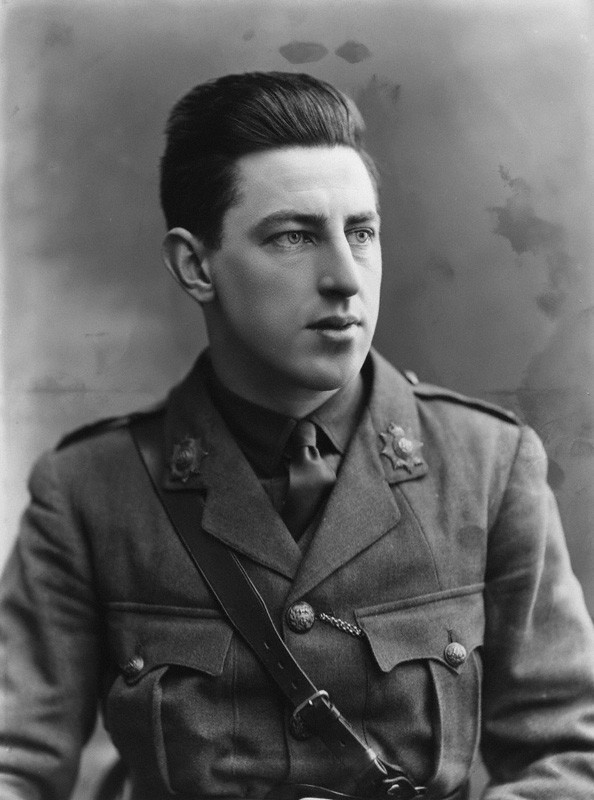
description
A British war surrealist painter, photographer, writer and illustrator, sculptor, a brilliant representative of the new landscape painting of the first half of the 20th century.
Paul Nash played a key role in the development of modernism in English art. He was a participant in the Roger Fry’s London Omega seminars (Vorticism, an art movement). In 1933, he became one of the founders of the brief but influential movement “Unit One”, the activity of which was an important step in the revitalization of British art during the interwar period.
The artist was a participant in both world wars and became famous for his series on the consequences of the battle of Ypres (paintings of 1918-1919), anthropomorphic images of airplanes (a number of works of the 1940s), and also rich in symbolism landscapes with strong mystical overtones. The painting “The Menin Road” by Paul Nash is still considered to be one of the most iconic images of the First World War, and the “Dead Sea” canvas is a symbolic image of the consequences of the Second World War.
Nash was also an excellent book illustrator; he designed scenery for the stage, created drawings for fabrics and posters, created organic sculpture and wood engravings.
The works of Paul Nash are in the collections of all the leading museums and galleries in England; his largest collection (87 paintings, drawings and documents) is in the London Tate Gallery.
Key ideas:
– The landscape painter gradually developed his style. Having graduated from the Slade art school, Nash worked in an impressionistic manner. As Cubism spread in art circles in England, Paul began practicing pointless landscapes, using elements of geometric painting and abstraction techniques.
– During the First World War, his paintings filled with pathos of humanism, which, according to Paul Nash, was the driving force of the world. The artist served in the army and, when possible, drew from life, including in the bomb shelters of the London Underground, made military photo reports. Sketches made at the scene became the basis of his oil painting.
– Nash’s work as a whole reflects the tragedy of the military generation, as well as the death of nature, which was the subject of his love and art, as he rejected figurative painting from the very beginning.
– Making friends with outstanding abstractionist B. Nicholson, Paul Nash organized a group of painters who “stood on the same artistic platform”. The association provided the basis for the development of avant-garde artists’ creativity and had a considerable influence on British artists of not only the 20th century.
– Paul Nash did not stop searching for ways of expression, becoming an already well-known master. Finding new painting, illustrating and sculpting techniques, the artist added grandeur even in formal in essence compositions, making his paintings look monumental.
– The style of Nash is characterized by the clear sense of the completeness of the compositional structure, even in surrealistic and abstract works, which he created at the end of his activity, basing on Freud’s theory.
1889
1910
1912
1914
1917
1918
1920
1924
1928
1930
1936
1940
1946
The birth of the artist
He entered the famous Slade Art School
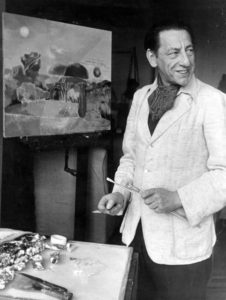 After studying at the Chelsea Polytechnic Institute at the London School of Photography and Lithography, he entered the famous Slade Art School (he did not complete his studies there). He failed to depict figures, so the beginning artist focused on landscape painting.
Conducted exhibitions with his brother John
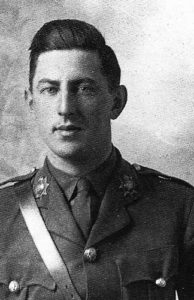 Conducted exhibitions in 1912 and 1913 with his brother John; their works were mostly drawings and watercolors with brooding landscapes inspired by the poetry of William Blake and the paintings of Samuel Palmer and Dante Gabriel Rossetti.
Became a member of the London group of artists
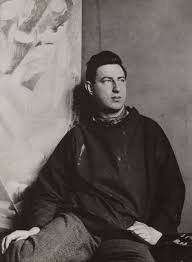 Worked under the guidance of Roger Fry at Omega workshops, became a member of the London group of artists. After the beginning of the war, he was called and carried out guard duty in the Tower of London, which allowed him to continue painting. Married Margaret Odeh.
Participated in a group exhibition at the Goupil Gallery
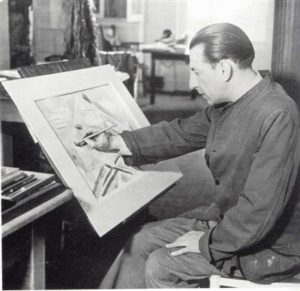 Experienced the influence of the vortex movement and their manifesto, published in the journal BLAST, participated in a group exhibition at the Goupil Gallery. Receiving the title of a military artist, he participated in the Third Battle of Ypres in Belgium.
Began working in the technique of oil painting
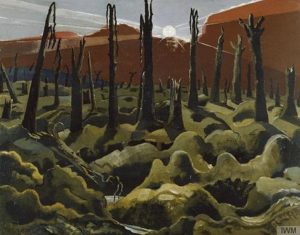
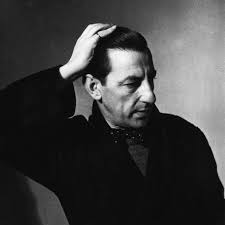 Began working in the technique of oil painting, turning numerous drawings made at the front into paintings. Among the first large canvases are his paintings “We are creating a new world” and “The Ypres Salient at Night”, which are included in the collection of the London Imperial War Museum.
Created theatrical projects for the play by James Barry
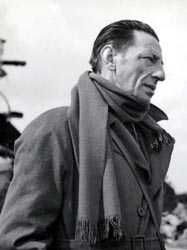 Created theatrical projects for the play by James Barry, joined the Society of engravers and participated in its first exhibition. He began teaching at the Kornmarket Art School in Oxford.
Taught at the School of Design at the Royal College of Art
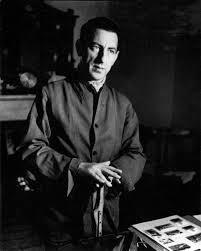 Taught at the School of Design at the Royal College of Art; among his students were Eric Ravilious, Edward Bawden and others. He held a commercially successful exhibition at the London gallery of Leicester. This allowed the artist to spend the winter in Nice, which was good to the artist who had asthma, and to visit Florence and Pisa at the beginning of 1925.
He was elected to the London Association of Artists
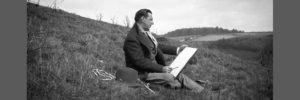 He was elected to the London Association of Artists, held one more successful exhibition at the Leicester Gallery; an exhibition of his engravings was held at the Redfern Gallery. Nash left his favourite landscape genre, began to study and apply abstraction under the influence of the London exhibition of avant-gardists.
He began working as an art historian
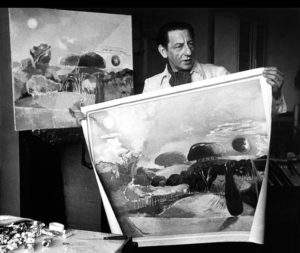 He began working as an art historian, visited Paris; then he became interested in the ideas and creative work of G. de Chirico and began to actively promote avant-garde European styles in Britain. Together with G. Moore, B. Nicholson, E. Wadsworth, he became one of the founders of the influential movement “Unit One”, which promoted contemporary art in the interwar period.
Participated in the First International Exhibition of Surrealists, held in London
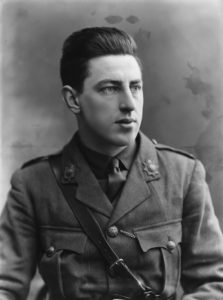 Participated in the First International Exhibition of Surrealists, held in London.
Paul worked for the Ministry of Aviation
 Consultative Committee of military artists appointed him to the full-time post of military artist; Paul worked for the Ministry of Aviation. As part of the contract, which lasted until 1944, the master painted four paintings, the most famous of which were “Totes Meer” (The Dead Sea) and “Battle of Britain”.
The death
 Paul Nash died on June 11, 1946 in Boscombe, Hampshire, the UK.